>> SYSTEM LOG //

THE
WALKER
EXCAVATIONS
Visit Our Exhibition!
Click here for tickets
ANCIENT ARTIFACTS
A unique exhibition showcasing strange objects from the depths of time
that has been dug up only to remain anomalies stuck in some fringe realm of history, and should not even exist at all
The Rosetta Stone
DESCRIPTION
Age: Circa 2221 years
Dimensions: 114x72x28 (cm)
Weight: 760 kg
Origin: Egypt
Material: Granodiorite
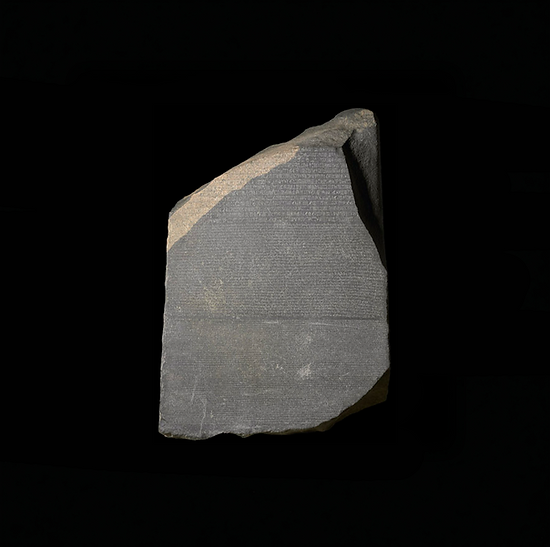
The Rosetta Stone is a fragment of a stele made of dark gray granodiorite, discovered in 1799 in Rosetta (Rashid) in Egypt. It measures approximately 114 × 72 × 28 cm and weighs over 760 kg. Engraved on its surface is a decree from 196 BC, written in three writing systems: hieroglyphs, Demotic, and ancient Greek. This made it the key to deciphering Egyptian hieroglyphs and a symbol of one of the greatest breakthroughs in the study of ancient Egypt.
What is the Rosetta Stone?
The Rosetta Stone is a fragment of a larger stele made of dark granodiorite, dated to 196 BC. It was created during the reign of the young pharaoh Ptolemy V Epiphanes, and its inscription commemorates his coronation and the granting of divine honors in exchange for tax relief and donations to temples.
Its uniqueness lies in the fact that the same text was inscribed in three different scripts:
Hieroglyphs – the official and sacred script of Egypt,
Demotic – the everyday and administrative script,
Ancient Greek – the administrative and scholarly language of the Hellenistic period.
For the ancient Egyptians, this was a practical solution – the decree was meant to be accessible to different groups of society. For 19th-century scholars, however, it became the invaluable key to deciphering hieroglyphs, which had remained mysterious for centuries.
Discovery and later history
The Rosetta Stone was discovered on July 15, 1799 by French officer Pierre-François Bouchard during fortification works near the city of Rosetta (modern Rashid) in the Nile Delta. The French engineers immediately realized its importance and produced plaster casts and lithographs, which quickly spread across Europe and stirred great interest among scholars.
After Napoleon’s defeat in Egypt, under the terms of the Capitulation of Alexandria (1801), the stone was handed over to the British. In 1802, it was transported to London and placed in the British Museum, where it remains to this day as one of its most visited artifacts.
The key to deciphering hieroglyphs
For centuries, no one was able to read hieroglyphs – they were thought to be purely symbolic. The Rosetta Stone changed everything.
Thomas Young, an English polymath, identified that some hieroglyphs recorded sounds, including the name “Ptolemy.” This proved their phonetic value.
Jean-François Champollion, a French linguist and expert in Coptic, made the decisive breakthrough in 1822. He demonstrated that hieroglyphs are a hybrid system – combining phonetic signs and ideograms. This allowed him to read the text and laid the foundation for a new science – Egyptology.
From that moment, scholars could finally understand ancient inscriptions, papyri, and tomb decorations, completely transforming our knowledge of Egyptian history.
Legacy and modern influence
The Rosetta Stone became a symbol of unlocking mysteries. The phrase “Rosetta Stone” has entered common use in English to mean a key to solving a complex problem.
The most famous modern reference was the Rosetta space mission by the European Space Agency. Its goal was to study comet 67P/Churyumov–Gerasimenko. In 2014, history was made when the lander Philae touched down on the comet’s surface — the first spacecraft landing on a comet in human history.
Just as the Rosetta Stone unlocked ancient hieroglyphs, studying the comet aimed to reveal the origins of the Solar System, including clues about the source of water and organic compounds on Earth. The mission ensured that “Rosetta” became immortalized not only in archaeology but also in the history of space exploration.
Controversies and ownership claims
For decades, Egypt has demanded the return of the Rosetta Stone, calling it a central part of its cultural heritage. Egyptian authorities argue that it was taken during a colonial era and should be repatriated.
In 2005, the British Museum sent Egypt a faithful replica, which was placed in the Bibliotheca Alexandrina. However, the original remains in London, and debates over its restitution continue, becoming part of a broader global discussion about the return of artifacts taken during colonial times.
Scientific significance
The Rosetta Stone is regarded as one of the most important discoveries in the history of science. Its decipherment:
enabled the reading of thousands of inscriptions and papyri,
revealed Egyptian religion, literature, science, and administration,
marked the beginning of Egyptology as a formal discipline.
It transformed ancient Egypt from a mysterious land of unreadable symbols into one of the best-documented civilizations of antiquity.
Fun facts
The stone measures about 114 × 72 × 28 cm and weighs over 760 kilograms.
The text of the decree is incomplete – the upper and side portions of the stele are missing.
The Rosetta Stone has become a pop culture icon – replicas exist in many museums, and the name has been adopted by, for example, the popular Rosetta Stone language-learning software.